


Playing chess requires a chessboard and a chess set containing 32 pieces. In this first lesson, I will explain the chessboard, the pieces and their relationship.
Here is the plan I propose for this lesson:
Table of Contents
The structure of the chessboard
The chessboard is a board made of 64 squares configured in 8 rows and 8 columns. The squares are arranged in 2 contrasted colors : one being dark and the other being light. Here is an example of a chessboard:
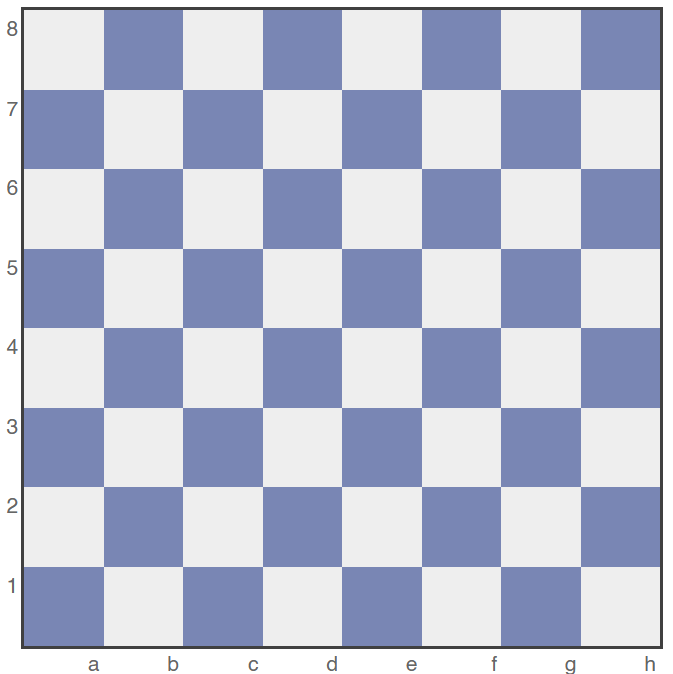
The chessboard is the battleground of a chess game. By looking at the image above, we can already see that it can be divided in several parts. We already mentioned rows and columns, but there are also the diagonals. In the chess world, we usually use the term “rank” when referring to a row and “file” when referring to a column. These three entities are really important for elaborating strategies. At the elite level, the players will often do anything they can to control a specific file, rank or diagonal. There will even have a ferocious battle just to control a simple square on the board!
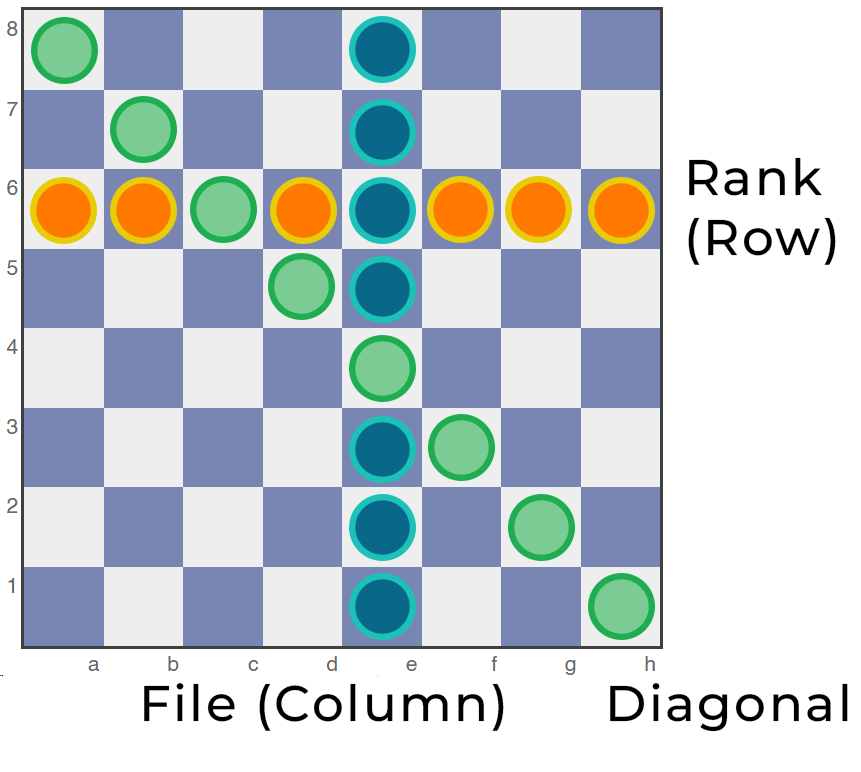
We identify the different ranks with numbers from 1 to 8. Thus, the bottom rank is called “1”, the following going up is called “2” until we reach the top rank which is called “8”. For the files, we use letters from “a” to “h” as their identifiers. The first file to the left is then called “a”, the following to the right is called “b” until we reach the rightmost column which is called “h”. To identify diagonals, we use another system which will be discussed later.
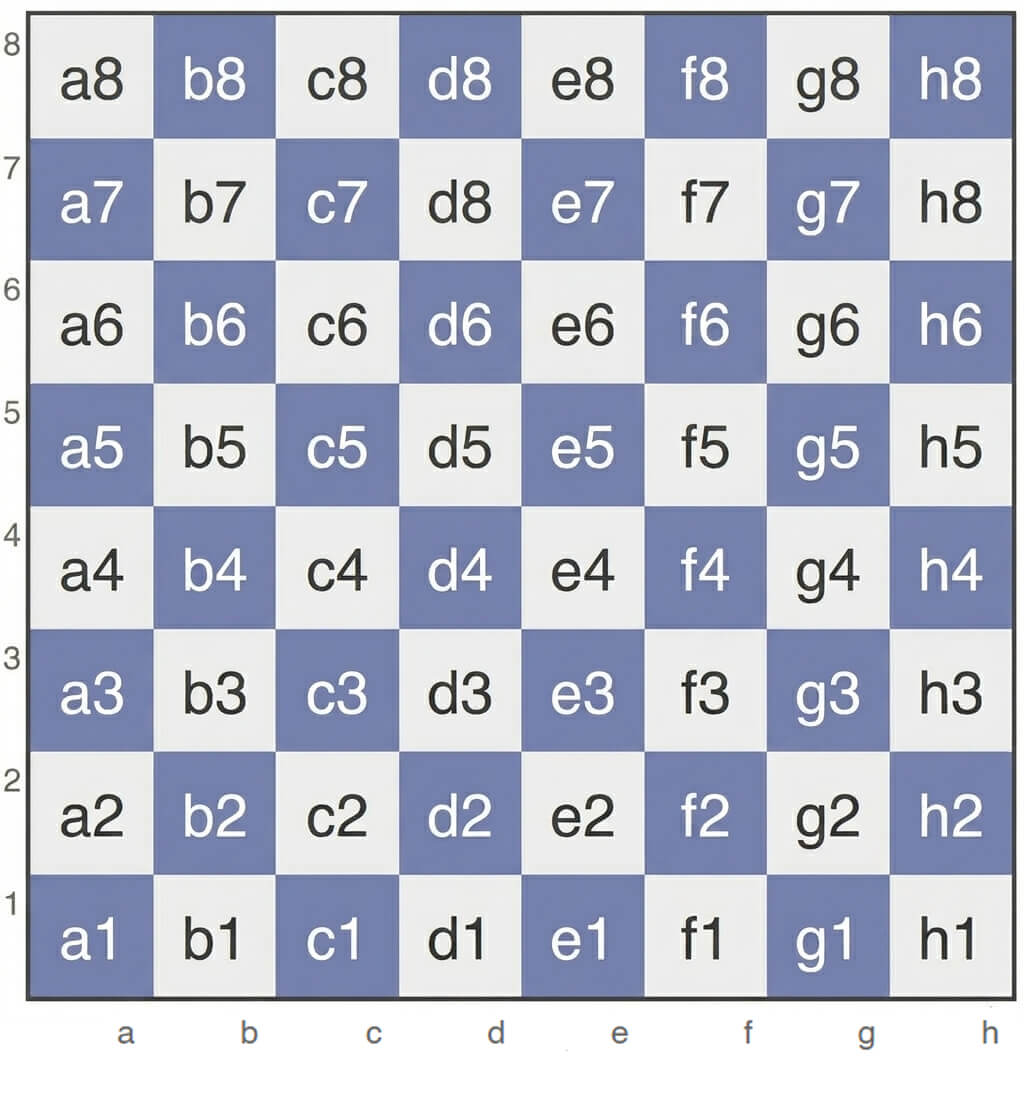
Squares are also pretty important on the chessboard. They are a potential “home” for the pieces and they are important enough to have a unique name associated to them. Their name is built from the position in the chessboard using the intersection of the rank and file they occupy. The first rank is then containing squares a1, b1, c1, d1, e1, f1, g1 et h1. The second rank is containing squares a2, b2, c2, d2, e2, f2, g2 et h2, and so on until the last 8th rank.
Please refer to the following diagram to get the name of all the squares:
Identifying The Chess Pieces
We already know that the chessboard contains 64 squares. Half of them, 32 squares, are occupied by the pieces at the beginning of the game. Both players have 16 pieces. Usually, we define both “armies” as being White and Black. Note that some chess sets, the pieces are not white or black. We can find red or light brown to represent White pieces and dark brown to represent Black. Generally, we used the lighter colour for the White side. From the 16 pieces owned by a player, 8 of them, the smaller ones, are called “pawns” and the others are called “figures”. There are 5 different figures: the Bishops, the Knights, the Rook, the Queen and the King. Let’s see what they look like:

The Pawn: each player owns 8 pawns at the beginning of the game.

The Bishop: each player owns 2 bishops at the beginning of the game.

The Knight: each player owns 2 knights at the beginning of the game.

The Rook: each player owns 2 rooks at the beginning of the game.

The Queen: each player owns only one queen at the beginning of the game.

The King: each player owns only one queen at the beginning of the game.
Let’s continue the lesson with the next page on starting position in chess, the wings and the center.