


Every chess game begins from the same position. The board is an 8×8 grid of 64 squares, and each player starts with 16 pieces: 8 pawns and 8 back-rank pieces that are arranged symmetrically. Once you know the chess pieces and the board, setting up correctly is the last step before you can play. Here is how to do it.
Get the board the right way round
Before placing anything, check the board is the correct way round. Each player should have a light (white) square in the right-hand corner nearest them. The simplest way to remember this is the rule “light on the right”. Put another way, the bottom-left corner square facing each player (a1 for White) is a dark square.
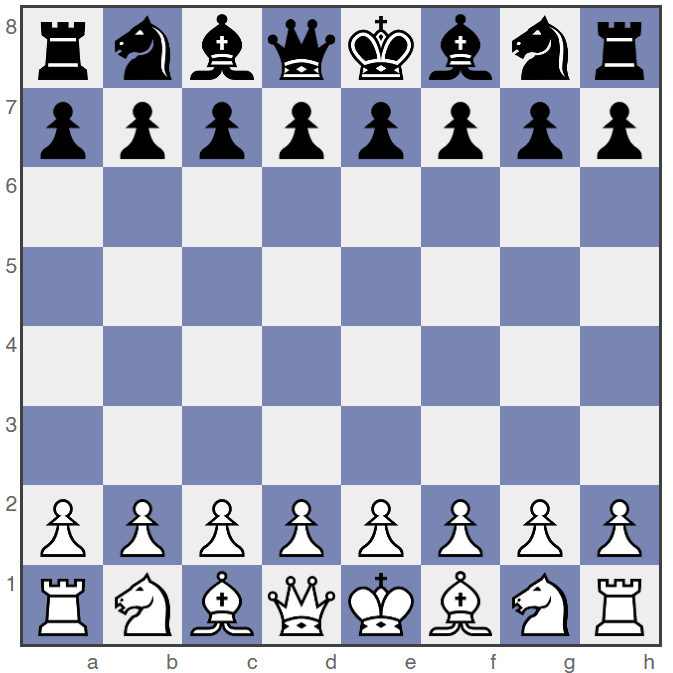
Place the pieces, step by step
- Place the pawns. Line up all eight pawns along the second rank in front of each player — rank 2 for White, rank 7 for Black.
- Place the rooks. One in each corner of the back rank.
- Place the knights. Directly beside each rook.
- Place the bishops. Beside the knights, towards the centre.
- Place the queen and king. The two central squares are left for the royals.
Read along the back rank from left to right, it is always: rook, knight, bishop, queen, king, bishop, knight, rook.
Which way round do the queen and king go? Use the mnemonic “the queen goes on her own colour”. The White queen sits on d1 (a light square) and the Black queen on d8 (a dark square); the king takes the remaining central square in each case (e1 and e8). Because the board is symmetrical, from each player’s own side the queen ends up on the left for White and on the right for Black.
Placement Cheat Sheet
If you just want the squares at a glance, here is where every piece belongs:
| Piece | White squares | Black squares |
| Rooks | a1, h1 | a8, h8 |
| Knights | b1, g1 | b8, g8 |
| Bishops | c1, f1 | c8, f8 |
| Queen | d1 (light square) | d8 (dark square) |
| King | e1 | e8 |
| Pawns | a2 to h2 | a7 to h7 |