


Did you get the opportunity to play a few games? Are you mastering the basic rules of the game explained in the previous lesson? If so, it’s time to learn about castling, one of the most important special moves in chess.
Castling is a unique rule that allows you to move two pieces —the King and a Rook — at the same time. It helps protect your King by moving it to a safer position while also bringing your Rook into play. This move is essential for building a solid defence and improving your position quickly.
The castling may sound simple, but there are a few nuances that you need to know about it. Here is what we will cover in this lesson:
Table of Contents
Why castling is a special move?
Castling is unique because it breaks several standard movement rules in chess:
- The King moves two squares instead of its usual one-square movement.
- Two pieces move at the same time (the King and a Rook).
- The Rook jumps over another piece (the King), which is not allowed in any other move.
No other move in chess allows two pieces to move simultaneously, making castling an important exception to standard gameplay. Because of its strategic significance, it comes with specific conditions that must be met before you can execute it.
How to do a castling move in chess
Now that we understand why castling is a special move, let’s go over how to perform it correctly. As you already probably understood, castling is a King’s move. To castle, you need to follow these steps:
- Move the King two squares horizontally — either to the left (queenside) or the right (kingside).
- Move the Rook to the square next to the King, jumping over it.
Let’s break this down for both types of castling:
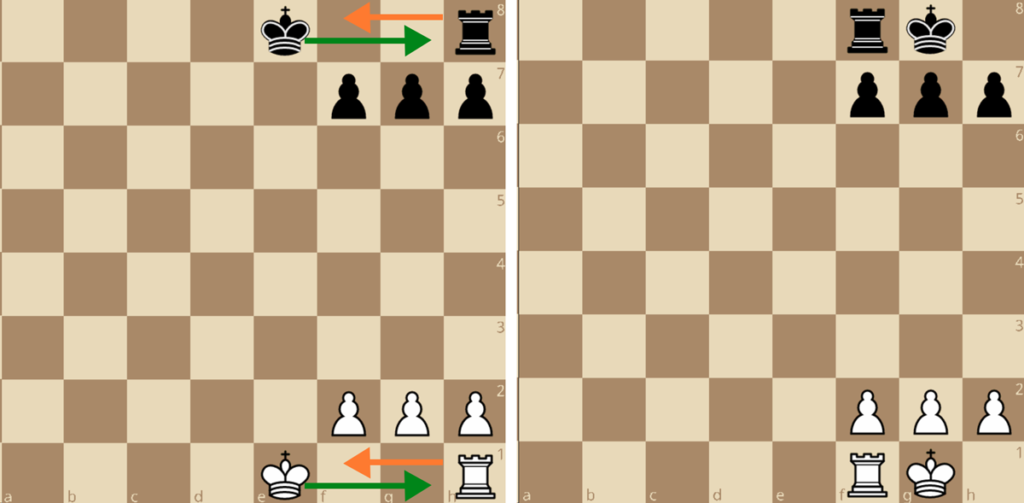
Kingside castling (short castling)
- White’s King moves from e1 to g1.
- The Rook from h1 jumps over the King and lands on f1.
- The final position: King on g1, Rook on f1.
For Black:
- The King moves from e8 to g8.
The Rook from h8 jumps over the King and lands on f8.

Queenside castling (long castling)
- White’s King moves from e1 to c1.
- The Rook from a1 jumps over the King and lands on d1.
- The final position: King on c1, Rook on d1.
For Black:
- The King moves from e8 to c8.
- The Rook from a8 jumps over the King and lands on d8.
Important rules to remember:
- The King must always be moved first — if you touch the Rook first, the move is not considered castling.
- No pieces can be between the King and the Rook before castling.
Rules of castling
You can see that castling is a powerful move, so no wonder there are specific restrictions. Castling can only be used under special conditions. Here are all the rules you need to follow:
- The King and the chosen Rook must not have moved previously. If either piece has moved earlier in the game, castling is no longer allowed.
- There must be no pieces between the King and the Rook. The squares between them must be empty for castling to be legal.
- The King cannot be in check. You cannot castle as a way to escape check — you must first get out of check before castling.
- The King cannot move through a square that is attacked by an opponent’s piece. If an enemy piece controls a square the King must cross, castling is illegal. Example: If Black’s bishop is attacking f1, White cannot castle kingside because the King must pass through f1 to reach g1.

- The King cannot land in check. The final square the King moves to must be safe.
- The Rook can be under attack, but not the King. A common misconception is that you cannot castle if the Rook is under attack — this is false. As long as the King follows the rules above, castling is allowed.
Why castling is useful in chess?
Castling is one of the most important defensive moves in chess. It serves two key purposes:
- It moves the King to safety – away from the centre of the board, where it is more vulnerable.
- It activates the Rook – bringing it towards the centre, where it can play a more active role in the game.
Without castling, your King remains exposed, and your Rook stays trapped in the corner, delaying your overall development.
In the opening phase, most attacks happen in the centre, where pieces are actively fighting for control. If your King stays in the centre too long, it becomes an easy target. By castling early, you relocate the King behind a wall of Pawns, making it harder for your opponent to attack. For example, after kingside castling, the King is shielded by Pawns on f2, g2, and h2 (for White), creating a strong defensive setup

The Rooks start in the corners of the board, blocked by other pieces. Until they move, they have no influence on the game. Castling immediately improves Rook activity by placing it closer to the centre, where it can control other squares and support future attacks. In some positions, castling queenside is even stronger because the Rook lands directly on a central line, influencing the game right away.
When you should castle in chess
“Castle early and often”
Rob Sillars
“Castle as early as possbile” – is a good rule, but you need to remember that it is a general one, which means it will work not for every game. For beginners, it is more safe to use it, rather not. However, as you improve, you’ll realise that castling isn’t always a must, and there are situations where delaying or even skipping castling can be a better choice.
When to castle early
In most cases, castling early is the best choice because it helps avoid unnecessary risks. You should castle as soon as possible if:
- The centre is open or likely to become open soon. An exposed King in an open centre is a serious weakness. If the position allows quick piece exchanges, your opponent may launch an attack before you can react.
- Your opponent has strong development, and your King is still in the centre. If your opponent controls the centre and is ready to attack, delaying castling can leave your King vulnerable.
- Your own development is almost complete. Once your minor pieces (Knights and Bishops) are developed, castling is usually the next natural move.
In general, castling early works well for most players, as it prevents unnecessary attacks and prepares the Rook for action.
When to delay or avoid castling
While early castling is often a good habit, there are specific situations where it’s best to wait or not castle at all.
1. When your opponent is preparing an attack on the side you want to castle.
If your opponent is advancing pawns aggressively toward the side where you plan to castle, you might be walking into trouble.
What to do instead?
- Consider castling to the other side (if safe).
- Keep your King in the centre temporarily and focus on counterplay.
2. When your king is already safe in the centre.
Sometimes, there’s no immediate threat in the centre, and your King is naturally safe behind a solid pawn structure. In such cases, castling may not be necessary right away. Castling in such positions could be a waste of time, as the King is already secure, and you might have more active moves to play.
Summary on castling timing
For most players, early castling is the safest and best option, especially in open positions. However, strong players recognise that castling isn’t a rule — it’s a tool. When deciding whether to castle, always ask yourself these questions:
- Is my King safe if I don’t castle?
- Is my opponent preparing an attack where I want to castle?
- Will castling now improve my position, or do I have a better move?
Understanding these principles will help you make better castling decisions, leading to stronger and more confident play.
Final Word
The main objective of castling is to put the King in a safety area during the most violent phases of the game. That’s the reason this move is usually done in the opening game. In most cases, castling is done prior to the fifteenth move.
In high level games, the side of the castling has a big influence on the development strategies of both players. Some players will even wait as long as they can before castling in order to keep their opponent in the mystery.