


“Any material change in a position must come about by mate, a capture, or a Pawn promotion.”
— Cecil Purdy
A Pawn may be the weakest piece on the board, but it holds the greatest potential. With promotion, a Pawn can transform into a powerful piece, often turning the course of the game. However, choosing the right promotion can make all the difference.
What Is Pawn Promotion?
Pawn promotion occurs when a pawn reaches the eighth rank for White or the first rank for Black. At this point, the player must replace the Pawn with another piece of the same color, except for a King or another Pawn. The choices include a Queen, Rook, Bishop, or Knight.
In standard chess notation, promotions are recorded by adding the chosen piece after the move:
- a8Q → The pawn moves to a8 and is promoted to a queen.
- fxe8N → The f-file pawn captures on e8 and is promoted to a knight.

Most of the time, players promote to a Queen — commonly called “queening” — because the Queen is the strongest piece. However, underpromotion, or choosing a different piece, is sometimes the better strategic decision.
When and why to underpromote in chess
Underpromotion happens when a player promotes a Pawn to a piece other than a Queen. While this may seem counterintuitive, underpromotion can serve specific strategic purposes:
1. Avoiding stalemate
Sometimes, queening a pawn leads to an immediate stalemate, costing the game. For example:
- If promoting to a Queen removes all legal moves for the opponent’s king but doesn’t deliver check, the game ends in a draw.
- Instead, promoting to a Rook or Bishop may keep the game going, allowing a checkmate.
On the next chess diagram you can see an example of a successful underpromotion to a Rook, which will let the player checkmate in a few moves.
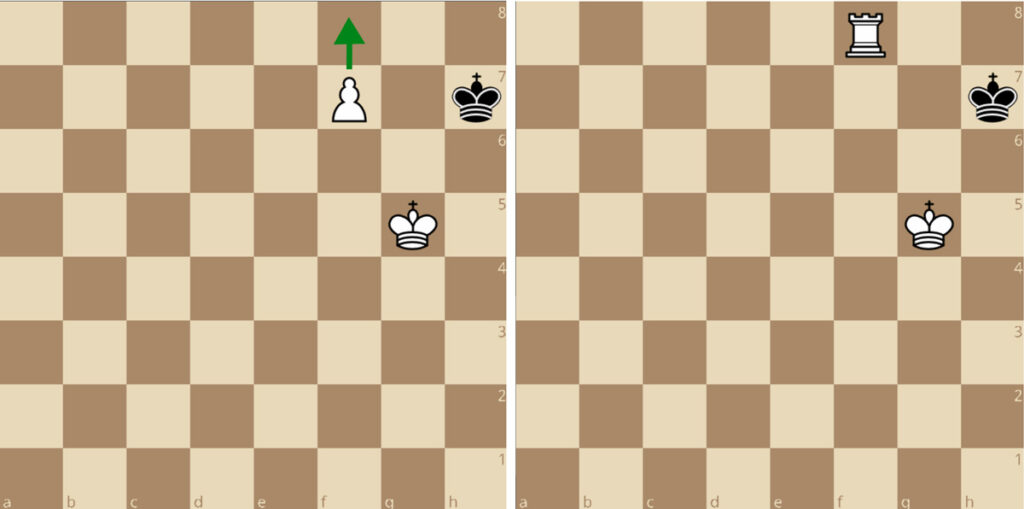
If the player would promote to the Queen, then the game would end in a drawn, as he is not under check, and all squares are blocked.
2. Delivering immediate checkmate
In some cases, promoting to a Knight is the only way to deliver an immediate checkmate. Unlike other pieces, a knight can jump over pieces, making it ideal for certain forced checkmating patterns. So if a Knight promotion delivers checkmate instantly, but a queen would allow the opponent to escape, underpromotion is the correct move.
This check diagram is a great example that shows a quick checkmate with underpromotion to the Knight:

The Black King is in check with by the Knight, and he has no moves because of the Bishop on d4, and Rook on g1. With the Queen that wouldn’t be an instant win.
3. Gaining a tempo
In high-level play, underpromotion can be used to gain a tempo (a crucial move that forces the opponent into a disadvantageous position). A great example in the real world was the game in 1986 between GM Anatoly Karpov and GM Jan Timman. Karpov promoted a Pawn to a Knight instead of a Queen. This prevented his opponent from forcing a perpetual check and secured his victory.
So Pawn promotion isn’t just about gaining the most powerful piece — it’s about choosing the right piece for the right situation. Mastering this concept can make the difference between a draw, a loss, or a brilliant checkmate.