


“The only good Rook is a working Rook!”
Samuel Reshevsky
If you did not go through the page explaining the general rules for moving pieces, I recommend that you do so before continuing.
Moving Rooks
Rooks can be qualified as being “heavy artilleries”. Indeed, they move in a straight line, horizontally or vertically and for an unlimited number of squares, giving them the possibility to cross the board in one move and control both colors on the chessboard.
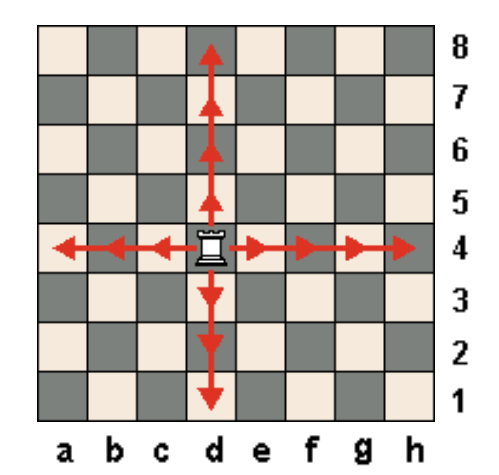
While moving, the rook must go in one direction only: up, down, left, or right. Since it cannot jump over other pieces, the rook is blocked when there is another piece (friend of foe) on its path.
Capturing With Rooks
The rook can capture the first piece being on its path in any direction. In the example below, the rook can capture either the pawn on d6 or the knight on a4. Note that if it takes the pawn, black would be able to capture the rook after with the pawn on e7 (protecting its friend on d6). The knight does not have the same luck. So the White player would make an excellent move by capturing it!
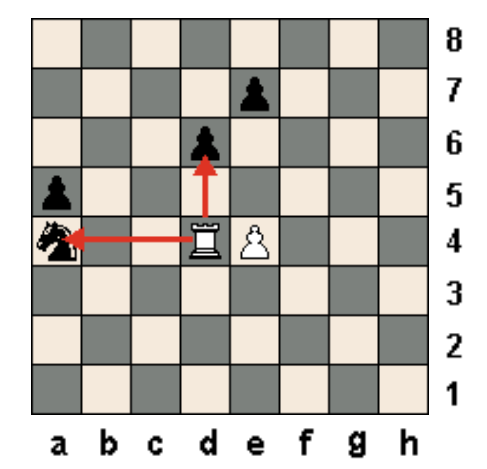
We can also note that the rook is blocked by his pawn on e4, meaning that it cannot move to its right. However, it can go backward (on d3, d2 or d1), forward (on d5 or capturing on d6) or go to its left (on c4, b4 or capturing on a4). Even if a square is not occupied, you have to be careful before moving your piece: the spot could look free and safe, but ensure that it is not controlled by an enemy piece. In the diagram above, the rook could indeed occupy the b4 square, but if we look closely at the position, we can see that Black’s a5 pawn is lurking this square (pawns capture pieces sitting on the first diagonal square in front of them)! Playing the rook on b4 would then be a bad move for White since they will lose it for nothing.
Let’s continue the lesson with the next page so we can learn how the queen moves.