


The 4-move checkmate is one of the quickest ways to win a game of chess, but it only works if your opponent doesn’t know how to stop it. So it usually works with beginners who are just starting out and haven’t learned basic opening principles yet. In online chess, this tactic might work against players rated under 800.
This pattern is also called Scholar’s Mate, Shepherd’s Mate, Shoemaker’s Mate. It usually targets the f7 square when you play as White, or the f2 square when you play as Black.
The idea of the checkmate in 4 moves is simple. You bring your Queen and Bishop out early to attack the square in front of your opponent’s King. If they don’t defend properly, you can deliver checkmate on your fourth move.
Table of Contents
How to do the 4-move checkmate step-by-step
To deliver the 4-move checkmate as White, you need to follow a simple plan: open the centre, bring your Bishop and Queen into active positions, and aim at the f7 square. Here’s how it works step by step for Whites:
1. E4

You start by moving your Pawn to e4. This controls the centre and opens lines for both your Queen and Bishop.
2. Bc4

Bring your bishop to c4. This puts pressure on the f7 square, which is weak because it’s only defended by the king.
3. Qh5 (or Qf3)

Next, place your queen on h5. This creates a direct threat: on your next move, you can capture the pawn on f7 with checkmate. Some players prefer Qf3, which also targets f7 and keeps the queen more central and safer.
4. Qxf7#

If your opponent doesn’t defend the threat, you take the pawn on f7 with your Queen which ends in a checkmate. The King cannot escape, block the check, or capture the Queen, and your Bishop protects the Queen from c4.
This sequence works only if Black plays passive or careless moves, like 2…Nc6 and 3…Nf6. If they defend correctly, the checkmate won’t happen — but the checkmate pattern is still useful to learn. It teaches you how to create threats and spot weak squares.
How to defend against the 4-move checkmate
If you’re playing as Black, it’s important to recognise the pattern before it’s too late. The critical position often comes after the third move from White.
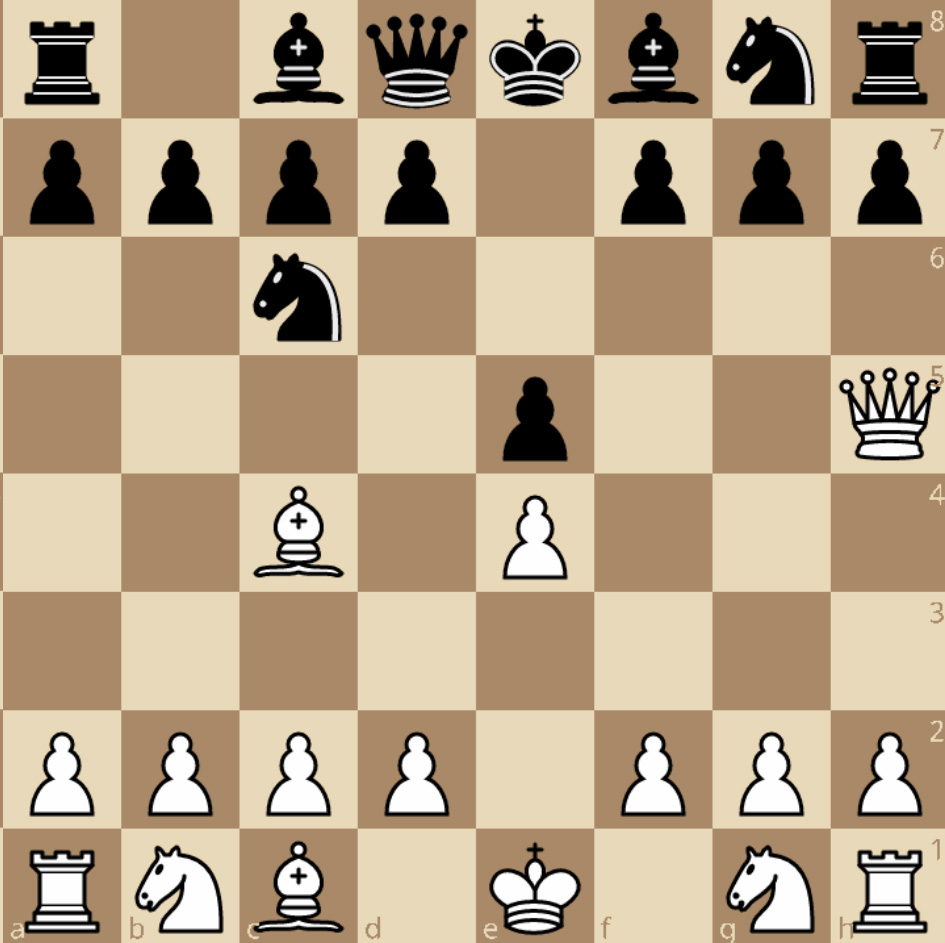
At this point, White is threatening checkmate with Qxf7. If you ignore the threat, the game could end on the next move.
Here are 3 simple ways to defend against it:
1. Play 3…Qe7 or Qf6

This is a good defence as it protects the f7 square and also supports the e5 pawn. The queen blocks the checkmate threat without weakening your position.
2. Play 3…g6

This pushes the Queen away from h5. After 4.Qf3, you can continue with 4…Nf6, and the immediate threat is gone.
When you stop the threat, White’s Queen may become a target. You can develop your pieces and look for ways to gain time by attacking the exposed Queen. Blocking the mate early often gives you a stronger position.
What to do if the scholar’s mate fails
If you’re playing as White and your opponent stops the 4-move checkmate, you should avoid trying to force it. After the Queen has moved out early, it’s often exposed and can be attacked by developing pieces. Instead of pushing for a quick win, it’s better to change your plan and focus on proper development.
Keep these points in mind:
- Move your Queen to safety if it’s under threat. Don’t leave it in a place where your opponent can gain time by chasing it.
- Develop your other pieces (knights and bishops) and prepare to castle. This will give you a solid position even if your early checkmate idea didn’t work.
- Don’t move the same piece multiple times in the opening, unless you have to. It usually slows down your development.
- Learn from the position. Even if the Scholar’s Mate doesn’t work, the setup teaches you to coordinate pieces and look for weaknesses.
Is scholar’s mate a good opening strategy?
Scholar’s Mate is helpful for learning how to attack, but it’s not a reliable opening if you are playing against experienced players. The early Queen move goes against standard opening principles, such as developing multiple pieces and controlling the centre with Pawns and minor pieces.
If you try Scholar’s Mate against someone who knows basic defence, you’ll often end up with a weak position. Your Queen may become a target, and your other pieces will still be undeveloped. So it’s better to play this opening with new players or friends for fun,
That said, this tactic is useful for beginners because:
- It teaches how to create threats early in the game.
- It shows how the queen and bishop can work together.
- It helps you recognise patterns involving weak squares like f7 and f2.
Once you understand how it works, it’s better to move on to structured openings that help you develop your whole army. These will give you a better chance of playing well throughout the game, not just in the first few moves. Below you can also found other chess tactics that is worth learning.