


There are six different chess pieces, and each one moves in its own way. Knowing how each piece moves is the foundation of the game. Without it, you can’t plan your strategy, spot threats, or take advantage of your opponent’s mistakes.
In this guide, you will learn:
- How each chess piece moves and captures
- Where each piece starts on the board
- The point value of each piece
- The three special moves every player needs to know
The Pawn
Point value: 1
Each player starts with eight pawns. White’s pawns start on the second rank (a2 to h2), and Black’s pawns start on the seventh rank (a7 to h7). They form the front row of each player’s army.

How the pawn moves
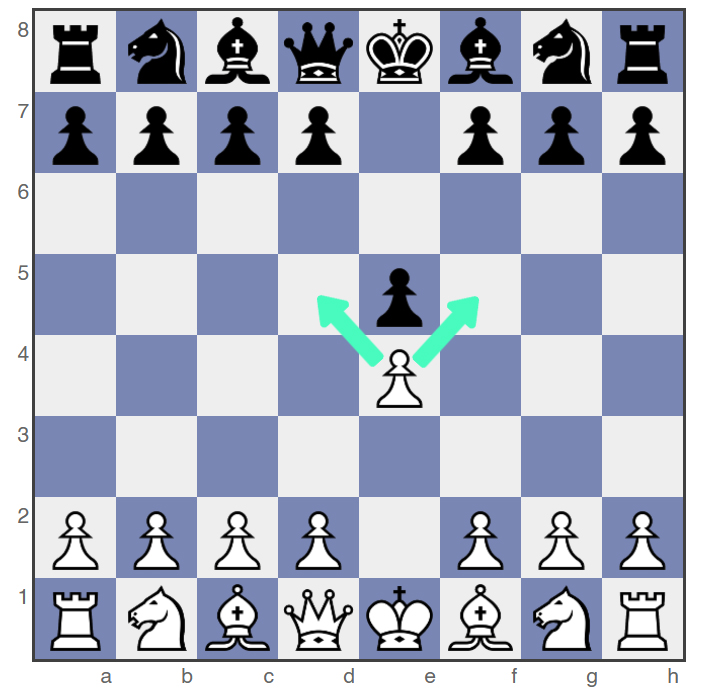
The pawn is the only piece that moves and captures in different ways. For movement, the pawn moves straight forward. On its very first move, it can advance either one or two squares. After that, it can only move one square at a time. The pawn can never move backward.
For capturing, the pawn attacks diagonally, one square forward to the left or right. It cannot capture a piece directly in front of it, only pieces on diagonal squares.
The Bishop
Point value: 3
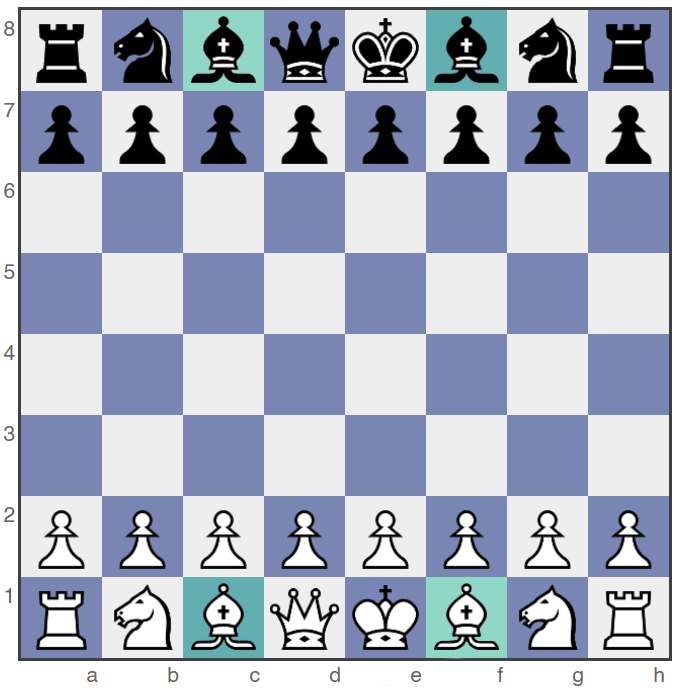
Each player starts with two bishops. White’s bishops start on c1 and f1, and Black’s bishops start on c8 and f8. One bishop starts on a light square, and the other starts on a dark square.
How the bishop moves
The bishop moves diagonally in any direction, as many squares as it likes. It can move forward or backward, but always on a diagonal line. Because of this, each bishop stays on the same colour square for the entire game. The bishop on a light square will always stay on light squares, and the bishop on a dark square will always stay on dark squares.
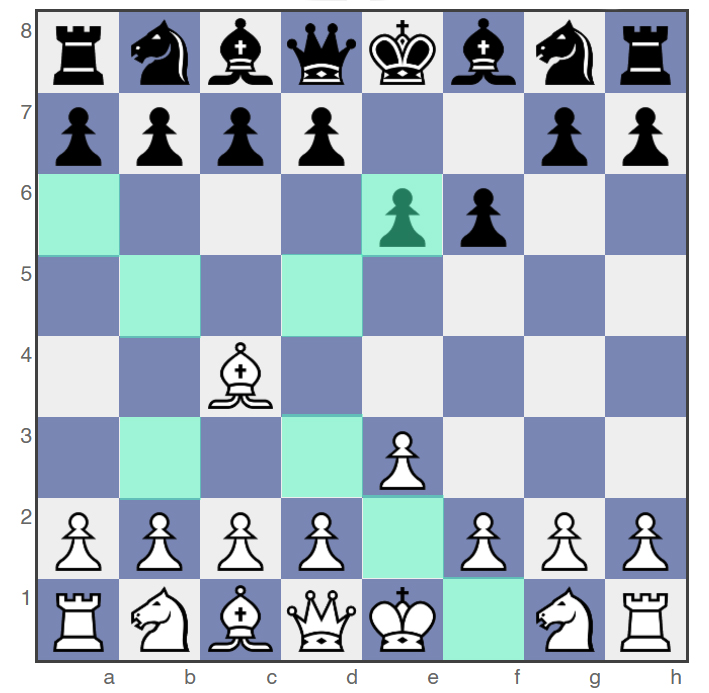
A useful way to remember the bishop move is to imagine a “X” shape from wherever it stands.
The Knight
Point value: 3
Each player starts with two knights. White’s knights start on b1 and g1, and Black’s knights start on b8 and g8.

How the knight moves
The knight moves in an “L” shape: two squares in one direction (horizontally or vertically), then one square perpendicular to that. It can move forward, backward, and to either side.
The knight is the only piece in chess that can jump over other pieces. It doesn’t matter what’s in between, the knight lands directly on its destination square. It can only capture a piece on the square it lands on, not any piece it jumps over.
From the center of the board, a knight can reach up to eight different squares. From the edge or corner, it has fewer options, which is why keeping knights toward the center is usually better.

The Rook
Point value: 5
Each player starts with two rooks. White’s rooks start on a1 and h1, and Black’s rooks start on a8 and h8, in the corners of the board.

How the rook moves
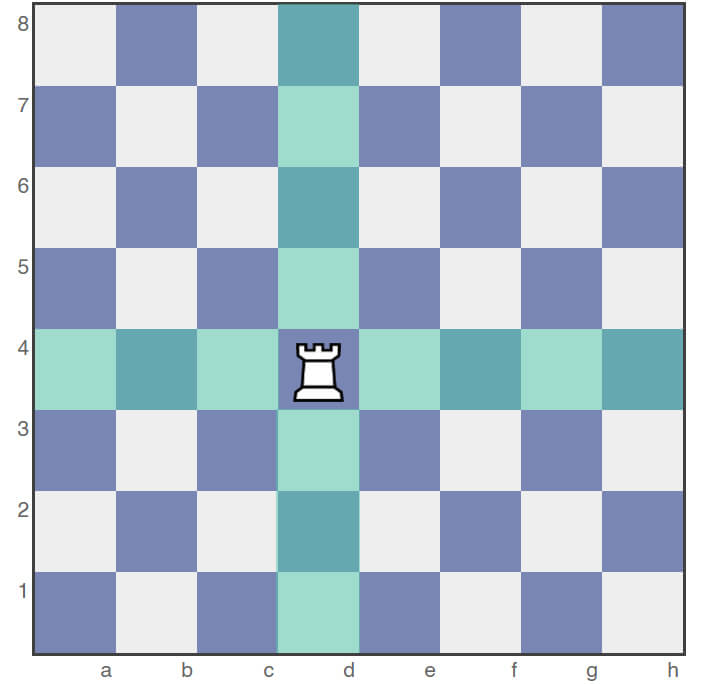
The rook moves in a straight line, horizontally or vertically, as many squares as it likes. It can move forward, backward, and sideways. A useful way to remember it: the rook moves in a “+” shape from wherever it stands.
The rook cannot jump over other pieces. If a piece is in its path, the rook must stop before it. It can capture the first enemy piece it reaches by moving to that square.
The rook is most effective in open files (columns with no pawns blocking the way) and on the back rank, where it can control large parts of the board.
The Queen
Point value: 9
Each player starts with one queen. White’s queen starts on d1, and Black’s queen starts on d8.

How the queen moves
The queen can move in any direction, horizontally, vertically, or diagonally, as many squares as it likes. This is basically a rook and a bishop combined into one piece.
Like the rook and bishop, the queen cannot jump over other pieces. If a piece is in its path, it must stop before it. It captures by moving to the square occupied by an enemy piece.
The queen is the most powerful piece on the board because of how many squares it can reach in a single move. From the center, it can control up to 27 squares at once.

The King
Point value: The king has no point value. It cannot be traded or captured.
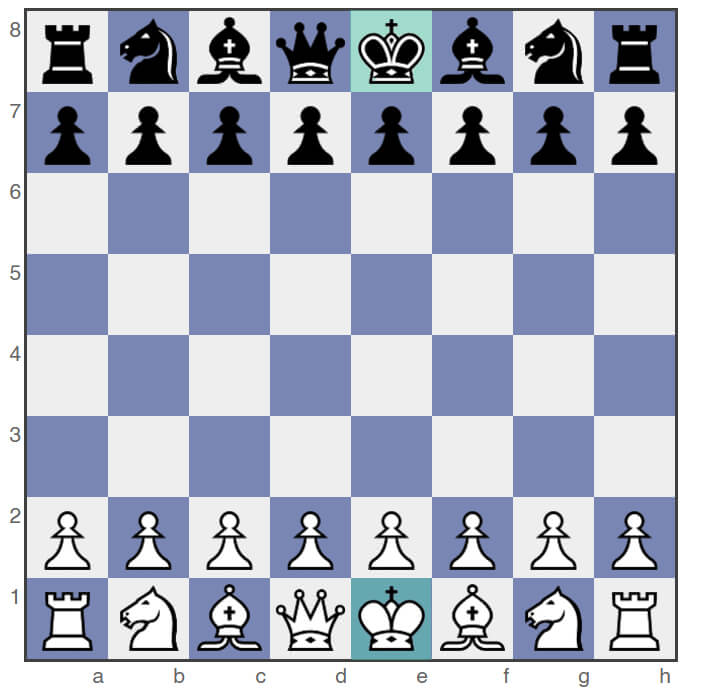
Each player starts with one king. White’s king starts on e1, and Black’s king starts on e8.
How the king moves
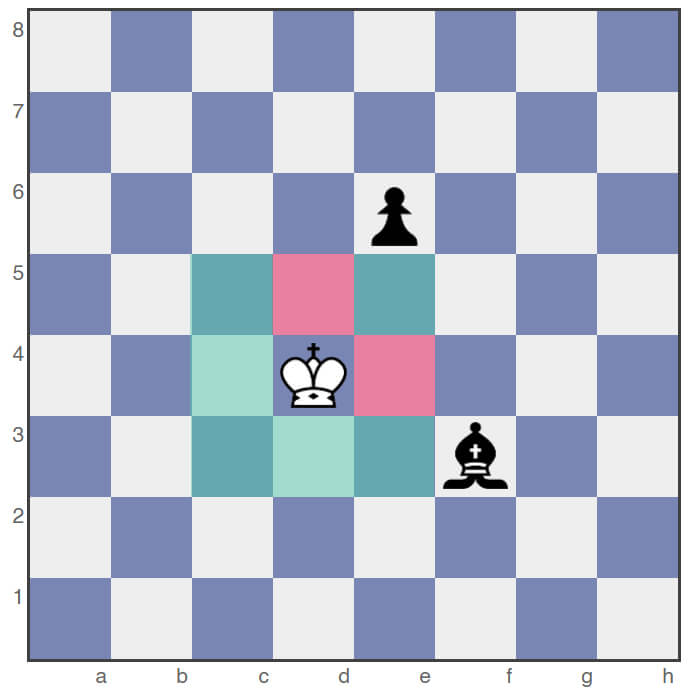
The king moves one square in any direction: forward, backward, sideways, or diagonally. It can capture an enemy piece by moving onto its square, as long as that square is not controlled by another enemy piece.
However, the king can never move to a square where it would be under attack. When the king is under attack, this is called check, and you must get out of it immediately. If there is no way to escape check, it is checkmate, and the game is over.
Because the king is slow and vulnerable, it needs to stay protected, especially in the early and middle stages of the game.
Special moves in chess
Beyond the standard moves, chess has three special moves you need to know. Each one has specific conditions that must be met before you can use it.
Castling is the only move in chess where two pieces move at the same time: the King and a Rook. The king moves two squares toward the rook, and the rook jumps to the other side of the king. You can castle on the kingside (short castling) or the queenside (long castling). Castling is mainly used to move the king to a safer position and activate the rook. To learn more about this special move, check our article about the castling rules.
En passant is a special pawn capture that can only happen in one specific situation: when your opponent moves a pawn two squares forward from its starting position, landing beside your pawn. On the very next move, you can capture that pawn as if it had only moved one square. If you don’t take the capture immediately, you lose the right to do it. Here is our tutorial to en passant if you want to learn more.
Pawn promotion happens when a pawn reaches the opposite end of the board (the 8th rank for White, the 1st rank for Black). At that point, you must replace the pawn with a queen, rook, bishop, or knight of the same color. Most players choose the queen, since it is the most powerful piece.
Final word
Below you will find more free chess tutorials covering rules, tactics, and checkmate patterns. Each guide is written with beginners in mind, so you can work through them at your own pace.
If you want to improve faster under the guidance of an experienced instructor, take a look at our chess coaching sessions. We work with both children and adults, online and in person.