


Not every black response to 1.e4 is equal. Some lead to losing positions out of the opening, some are playable but passive, and a few give you real winning chances at every level.
To build this ranking, we looked at four main factors:
- Soundness. The opening needs to hold up against strong play from White. If it can be clearly punished with basic chess principles, it doesn’t make the list.
- Practical results. Theory is one thing, but we also considered how these openings perform in real games, from club level to grandmaster level.
- Clarity of ideas. A good opening gives you a clear plan. You should know where your pieces are going and what you are trying to achieve in the middlegame.
- Learning curve. Some openings require deep theoretical knowledge before they become useful. We factored in how quickly you can start playing an opening effectively.
This ranking was put together based on discussions with our chess coaches, who work with players across different levels and styles. The goal is to give you a practical, honest guide, not just a list of opening names. We have also embedded interactive chessboards, so that you could practice the openings.
The Best Black Responses to 1.e4 (Ranked and Explained)
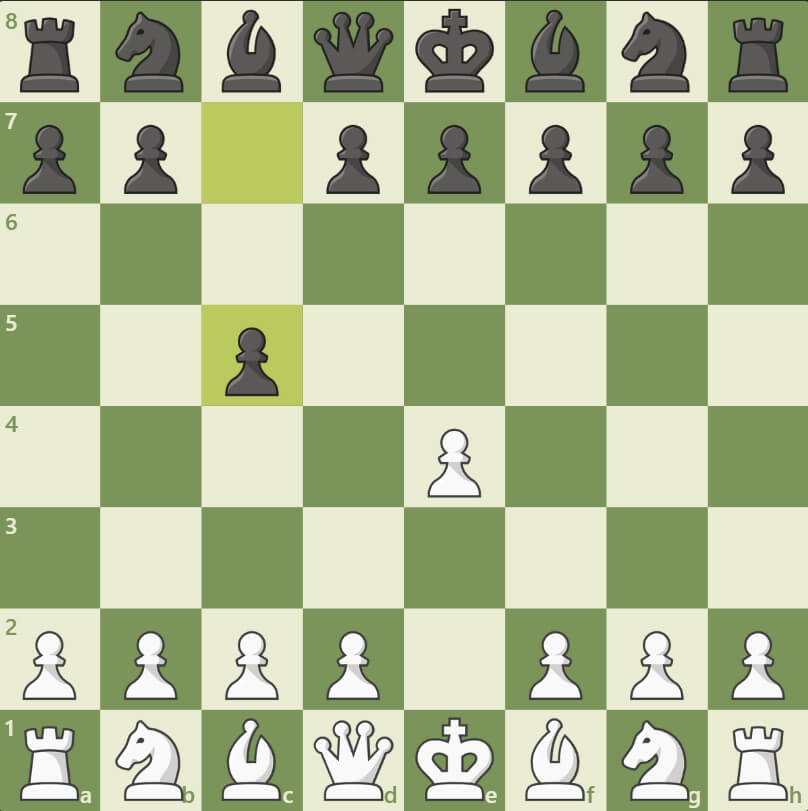
1. The Sicilian Defense (1…c5)
The Sicilian Defense is the most popular and most played response to 1.e4 at every level, from club players to world champions. Black avoids a symmetrical center and instead fights for control from the queenside. This creates an unbalanced position where both sides have real winning chances.
By playing 1…c5, Black avoids giving White an easy, symmetrical game. White controls the center with pawns on e4 and d4, but Black gets a half-open c-file and queenside counterplay. The positions are asymmetrical, which means both sides are playing for a win rather than a draw.
Main variations you need to know:
The Open Sicilian (after 2.Nf3 and 3.d4) is the most theoretical and often considered the most fun. Within it, the most important lines are:
- The Najdorf (1…c5 2.Nf3 d6 3.d4 cxd4 4.Nxd4 Nf6 5.Nc3 a6): Black prepares …e5 or …b5 and creates active queenside play. Favored by Fischer and Kasparov. Now try it out yourself following the steps on the chessboard below.
- The Dragon (1…c5 2.Nf3 d6 3.d4 cxd4 4.Nxd4 Nf6 5.Nc3 g6): Black fianchettoes the bishop on g7 and gets a powerful long diagonal. White usually attacks on the kingside, Black on the queenside. Sharp and double-edged.
- The Classical Variation (5…Nc6): Less committal than the Najdorf. Black develops naturally and keeps more flexibility.
- The Accelerated Dragon (1…c5 2.Nf3 Nc6 3.d4 cxd4 4.Nxd4 g6): Similar to the Dragon but Black avoids the Yugoslav Attack by not playing …d6 first.
Who should play the Sicilian: Players who want to fight for a win with Black and are willing to study. The Open Sicilian especially requires learning specific lines, but the reward is a dynamic position with clear attacking chances.
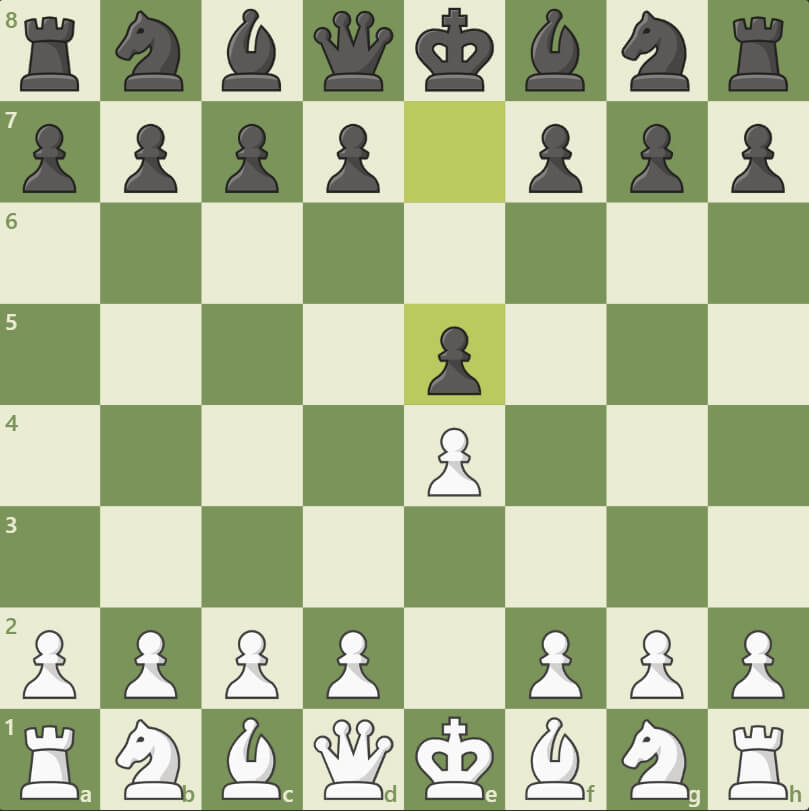
2. The Classical Response (1…e5: )
1…e5 is the oldest and most straightforward reply to 1.e4. Black immediately claims an equal share of the center. White cannot simply ignore it, which means the game develops naturally for both sides.
The main reason beginners are taught this move first is that it follows opening principles directly: control the center, open lines for your pieces, and develop quickly. It’s simple, but it is not just a beginner move. The classical response has been played at world championship level throughout the entire history of chess.
Main variations you need to know:
- The Ruy Lopez (1.e4 e5 2.Nf3 Nc6 3.Bb5): The most common and deeply studied continuation. White pins the knight that defends the e5 pawn. Black has several solid replies, with the Morphy Defense (3…a6) being the most popular. The positions tend to be strategic with long middlegames.
- The Italian Game (2.Nf3 Nc6 3.Bc4): White targets the f7 square early. The Giuoco Piano (3…Bc5) and the Two Knights Defense (3…Nf6) are the two main responses for Black. The Italian has become very popular at the top level in recent years due to its rich strategic ideas.
- The Petrov Defense (2.Nf3 Nf6): Black mirrors White’s knight development instead of defending e5. It leads to solid, symmetrical positions. It is a reliable choice if you want to avoid sharp theory, but the positions can lead to draws at a high level.
- The Philidor Defense (2.Nf3 d6): Black supports the e5 pawn with the d-pawn. It is solid but passive. Black gives White a slight space advantage early on.
Who should play 1…e5: This is the right choice if you are a beginner learning how to open your games. It is also a strong, reliable option for experienced players who want a principled, well-tested position. The theory is deep but logical, so it is not hard to understand the ideas behind each move.
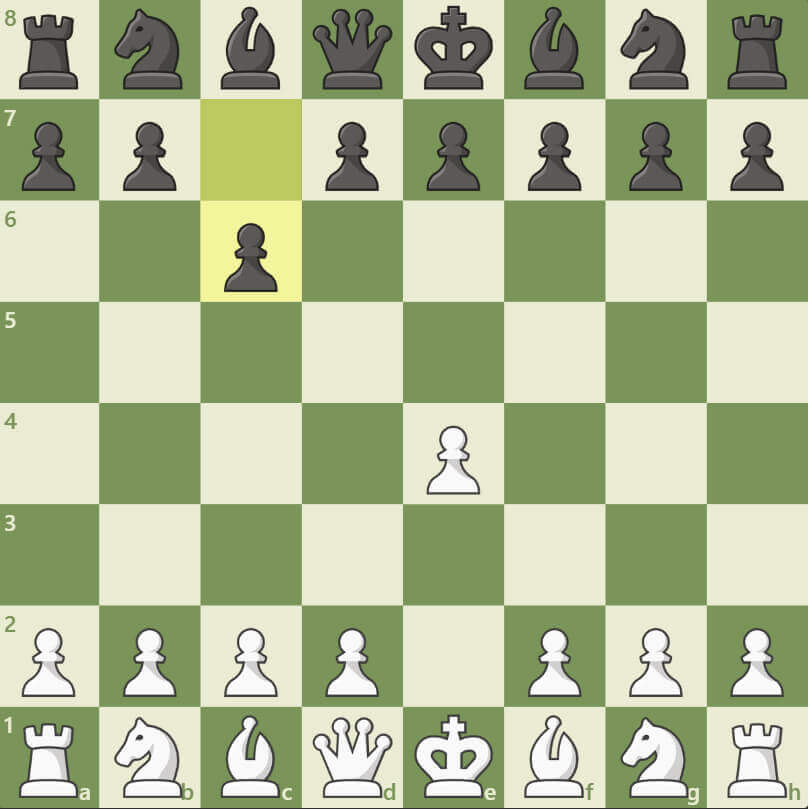
3. The Caro-Kann Defense (1…c6)
The Caro-Kann Defense starts with 1…c6. The idea is to follow up with 2…d5, challenging White’s center while keeping the light-squared bishop outside the pawn chain. This is the key difference from the French Defense, where the bishop gets locked in early.
The result is a solid position where Black has fewer weaknesses than in most other openings. The pawn structure is clean, and Black’s pieces have clear squares to develop to. This is why the Caro-Kann is popular at every level, from club players to top grandmasters.
Main variations you need to know:
- The Classical Variation (3.Nc3 or 3.Nd2 dxe4 4.Nxe4): White recaptures with the knight and Black plays 4…Bf5, developing the light-squared bishop before closing the position. This is the most important thing to do in the Caro-Kann, and the Classical Variation makes it easy. Black gets a comfortable, solid game.
- The Advance Variation (3.e5): White grabs space immediately by pushing the pawn to e5. Black responds with 3…Bf5, again getting the bishop out before the chain closes. The positions are similar to the Advance French but Black has an easier time because the c8 bishop is already active.
- The Exchange Variation (3.exd5 cxd5): White trades pawns and gets a symmetrical pawn structure. The game becomes more open and positional. Black has no problems equalizing here, but the positions can be dry.
- The Fantasy Variation (3.f3): White plays aggressively, trying to build a strong center with f3 and e4. It is less common but can catch unprepared players off guard. Black should respond with 3…dxe4 4.fxe4 e5, hitting the center immediately.
Who should play the Caro-Kann: It works well for positional players who want a solid structure without giving up the light-squared bishop. It is also a good choice if you find the French Defense appealing but dislike the passive bishop problem.

4. The French Defense (1…e6)
The French Defense starts with 1…e6, preparing to challenge White’s center with 2…d5. Black accepts a slightly cramped position in exchange for a solid pawn structure and clear counterplay on the queenside.
The main drawback is the light-squared bishop on c8. After the pawns settle on e6 and d5, this bishop gets blocked in and can stay passive for a long time. Managing this piece is the central challenge of playing the French Defense.
Main variations you need to know:
- The Classical Variation (3.Nc3 Nf6): Black develops the knight and directly challenges White’s center. White can play 4.e5 pushing the knight back, or 4.Bg5 pinning it. The positions are rich and strategic.
- The Advance Variation (3.e5): White grabs space and locks the center. Black plays 3…c5, immediately attacking the base of White’s pawn chain. The game splits into queenside play for Black and kingside play for White. Black needs to advance the queenside pawns quickly with …a6, …b5, and …c4 before White builds a dangerous attack.
- The Winawer Variation (3.Nc3 Bb4): Black pins the knight and creates immediate tension. After 4.e5 c5 5.a3 Bxc3+ 6.bxc3, White gets a doubled pawn structure but gains the bishop pair and attacking chances. This is one of the sharpest and most theoretical lines in the French.
- The Tarrasch Variation (3.Nd2): White plays a quieter move, avoiding the pin from …Bb4. Black has two main responses: 3…Nf6 for a solid game or 3…c5 for immediate central counterplay. The Tarrasch leads to positions that are easier to understand than the Winawer or Classical lines.
The pawn structure is the key to understanding the French. In most lines, White attacks on the kingside and Black counterattacks on the queenside. If you castle early as Black without advancing the queenside pawns, White can build a strong kingside attack using the bishop on d3 and moves like Qe2 and Ng5.
Who should play the French Defense: It suits patient, strategic players who are comfortable in slightly cramped positions and enjoy long-term pawn play. If the passive bishop bothers you, the Tarrasch or Exchange variations give you an easier time with piece activity.
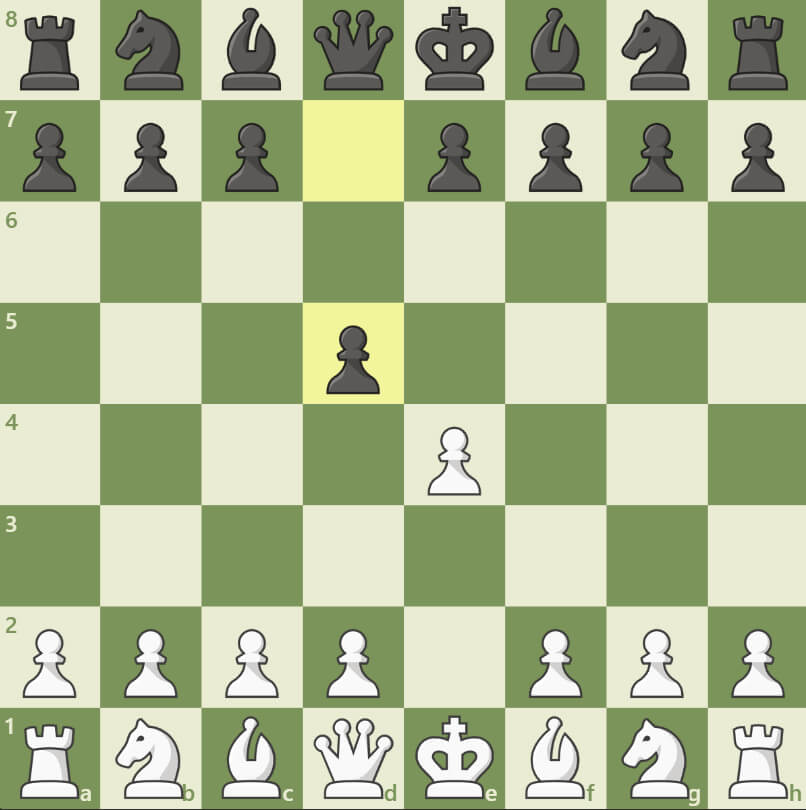
5. The Scandinavian Defense (1…d5)
The Scandinavian Defense starts with 1…d5, directly challenging White’s pawn on e4 from move one. After 2.exd5, Black has two main ways to recapture.
The most common is 2…Qxd5, bringing the queen out early. White responds with 3.Nc3, attacking the queen and gaining a tempo. Black then moves the queen, usually to 3…Qa5 or 3…Qd6. The early queen move is the main criticism of this line: Black spends extra moves repositioning the queen while White develops naturally. In return, Black gets a clear pawn structure and an active queen that can influence the game early.
<iframe id=”14652199″ allowtransparency=”true” frameborder=”0″ style=”width:100%;border:none;” src=”https://www.chess.com/emboard?id=14652199″></iframe><script nonce=”chesscom-diagram”>window.addEventListener(“message”,e=>{e[‘data’]&&”14652199″===e[‘data’][‘id’]&&document.getElementById(`${e[‘data’][‘id’]}`)&&(document.getElementById(`${e[‘data’][‘id’]}`).style.height=`${e[‘data’][‘frameHeight’]+37}px`)});</script>
Key ideas for Black in the Scandinavian:
The most important thing is to develop the bishops quickly, especially the light-squared bishop to f5 before playing …e6, which would lock it in. If Black achieves a setup with the bishop active on f5, the queen stable on a5, and the knights developed, the position is comfortable. White will try to exploit the early queen development by chasing it with tempo moves, so Black needs to be precise with queen placement.
Who should play the Scandinavian: It suits players who want a straightforward pawn structure from move one and are comfortable defending a slightly passive position in the early middlegame. It is playable at all levels, but it requires good piece coordination to avoid being pushed back by White’s space advantage.
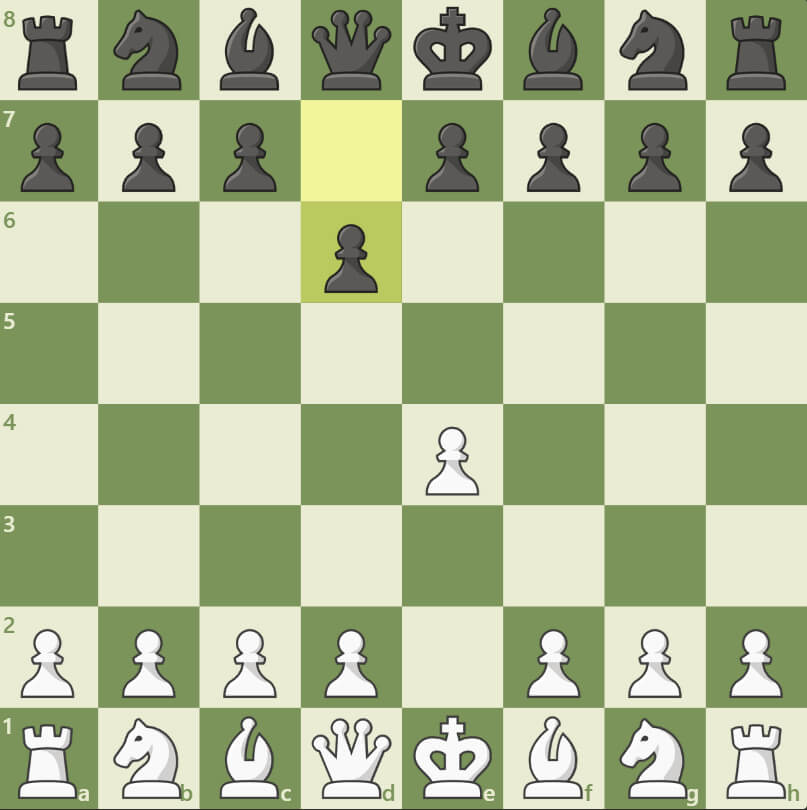
The Pirc Defense (1…d6)
The Pirc Defense starts with 1…d6, followed by …Nf6 and …g6. Black lets White build a strong center with pawns on e4 and d4, then attacks it from the sides with pieces and pawn breaks. This is called a hypermodern approach.
The setup for Black is consistent across most lines: fianchetto the bishop to g7, castle kingside, and then launch counterplay with …c5 or …e5 depending on what White plays.
Main variations you need to know:
- The Classical Variation (4.Nf3 Bg7 5.Be2): White develops quietly and prepares to castle. Black gets a comfortable setup with …0-0, …c6, and …e5 or …c5. This is the most straightforward line for both sides.
- The Austrian Attack (4.f4): White plays aggressively, building a pawn center with e4, d4, and f4. The plan is to push f5 and attack Black’s kingside. Black needs to react quickly with …c5 to hit the center before White builds too much space. This is the sharpest and most dangerous line Black faces in the Pirc.
- The Yugoslav/Byrne Variation (4.Bg5): White pins the knight on f6 immediately. Black can respond with …Bg7 and …0-0, accepting a slightly passive position, or play …c6 to prepare …d5 and free the position.
Who should play the Pirc: It works well for players who are comfortable in dynamic, counterattacking positions and do not mind giving up space early. It also suits players who already know the King’s Indian Defense, since the pawn structures and piece activity are similar.
Final word
Choosing the right opening against 1.e4 is not about finding a secret weapon. It is about picking a system that matches how you like to play and then understanding it deeply enough to handle what White throws at you.
Whichever opening you choose, the most important thing is to understand the ideas behind it, not just memorise the moves. Know where your pieces belong, know what pawn breaks to look for, and know which side of the board you should be playing on.
If you want to keep building your chess knowledge, below you can find our other lessons on chess tactics. And if you want to grow even faster, our chess coaching sessions might be exactly what you need. Our coaches work with players of all levels, from complete beginners to those preparing for tournament play.